
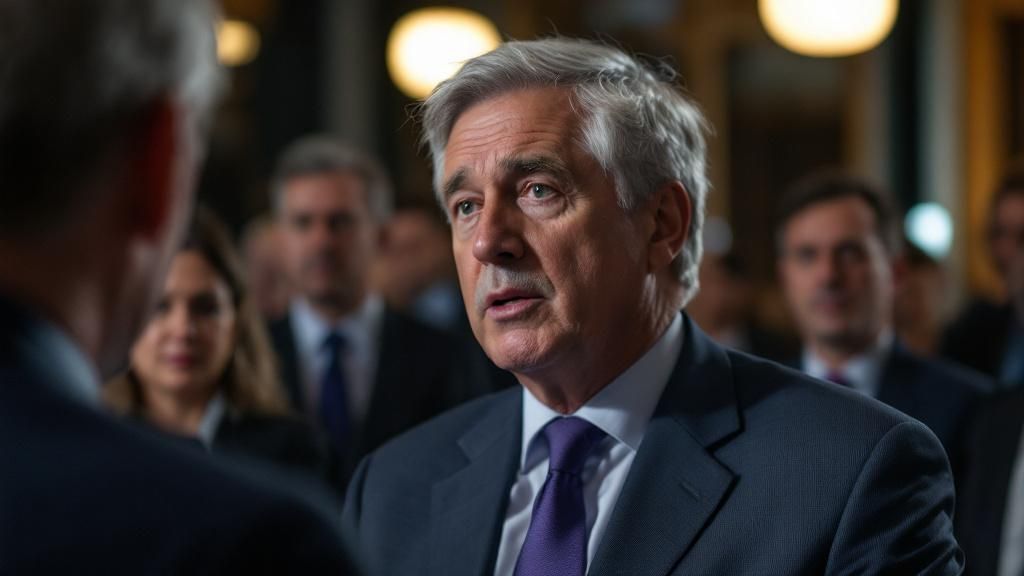
As families throughout the country grapple with rising energy bills and price increases climbing to record levels, the opposition figurehead has initiated a biting attack on the Government’s response to the cost-of-living emergency. In a tense Commons clash, the Labour party has questioned the administration’s insufficient support measures, demanding greater action to help struggling families. This article analyses the intensifying divisions centred on the crisis and explores the competing proposals for economic assistance.
The Opposition party’s Critique of Government Policy
The opposition leader has intensified scrutiny of the government’s response to the mounting cost-of-living emergency, arguing that existing policies fail significantly to addressing the scale of hardship impacting British families. Throughout parliamentary proceedings, the opposition has set out a detailed critique covering limited financial aid, limited involvement in the energy sector, and a perceived lack of commitment to combating inflation. The opposition contends that whilst families struggle with extraordinary costs, the government’s piecemeal approach only addresses surface issues rather than dealing with fundamental causes of financial hardship.
Central to the opposition’s case is the contention that the government has fundamentally misjudged both the extent and timeframe of the crisis. Opposition representatives have underscored statistical evidence suggesting that millions of people now face genuine hardship, with many obliged to select between keeping warm and feeding themselves. The opposition contends that the government’s first response underestimated the crisis’s consequences, leading to relief measures that turned out to be insufficient when conditions worsened further. This wrong assessment, they argue, demonstrates systemic weaknesses in forecasting accuracy and preparedness.
Limited Support Systems
The opposition has specifically targeted state assistance programmes as lacking in scope and precision, contending that price regulation frameworks fall short of protecting at-risk groups adequately. Commentators highlight that whilst the government has introduced multiple support measures, encompassing grants and council tax rebates, such provisions provide only temporary relief without resolving structural challenges. The opposition argues that income-assessed support remain too restrictive, excluding millions of employed households who yet face difficulties with mounting expenses. In addition, they argue the government’s approach lacks the boldness required to tackle such an extraordinary financial crisis.
Opposition assessment suggests that present welfare systems disproportionately disadvantage those earning mid-range salaries who miss out on access requirements for targeted assistance. The party has put forward different approaches incorporating across-the-board allowances, enhanced benefit programmes, and direct government intervention in energy markets to stabilise prices. They emphasise that short-term solutions, albeit positive, fail to replace deep-rooted transformation. The opposition argues that in the absence of significant law changes and enhanced government funding, households will continue experiencing severe money pressures in the coming period.
Long-range Financial Policy Challenges
Beyond pressing crisis intervention, the opposition has raised fundamental questions regarding the government’s long-term economic strategy and competitive position. Opposition analysts argue that the current approach emphasises short-term political optics over long-term economic sustainability, risking damage to Britain’s future prosperity. They contend that without targeted investment in renewable energy infrastructure, productive capacity, and workforce development, the nation risks prolonged economic stagnation. The opposition underscores that addressing cost of living pressures requires extensive reforms targeting output efficiency, technological innovation, and industry development alongside immediate relief measures.
The opposition has outlined concerns that government policy lacks coherence across different sectors, with energy policy, industrial strategy, and fiscal measures working independently rather than as integrated components. Critics argue this piecemeal framework hinders resolution of underlying inflationary pressures and deep-rooted economic issues. The opposition advocates for a coordinated national strategy encompassing energy transition, manufacturing revival, and skills development. They maintain that true economic recovery demands transformative policy reform rather than modest changes to existing frameworks.
Government’s Defence and Counterarguments
The government has firmly defended its economic strategy, arguing that the affordability pressures are largely driven by international forces beyond Westminster’s immediate reach. Ministers have highlighted the exceptional character of the energy shortage, stemming from international tensions and worldwide supply chain interruptions. They argue that their tailored support schemes, covering the price cap on energy and living cost payments, represent a balanced and economically prudent approach. The Treasury maintains that profligate expenditure could compound inflation even more, compromising long-term economic stability and in the end prejudicing the very households the opposition professes to defend.
Government representatives have stressed the significant monetary support already deployed, totalling billions of pounds in direct support to those in need. They contend that their policies balance immediate relief with disciplined budgeting, avoiding the debt spiral that unchecked spending could provoke. Ministers also draw attention to their initiatives in strengthening energy independence through sustainable energy projects and supply diversification. The government contends that whilst the opposition provides sympathetic language, their suggested policies lack economic credibility and would prove unsustainable without raising tax rates or greater public borrowing.
Furthermore, government officials highlight their dedication to tackling underlying economic challenges through efficiency enhancements and enterprise investment schemes. They maintain that sustainable recovery demands structural economic reforms rather than short-term payments. The government believes this method eventually provides increased wealth and security for all citizens.
